AICTE ATAL Sponsored Six Days Online Faculty Development Program

SRM Valliammai

Electrical and Electronics Engineering

The Electrical and Electronics Engineering department of SRM Valliammai Engineering College was started in the year 2001. The Electrical and Electronics Engineering programme is duly approved by the AICTE and affiliated to ANNA University, Chennai.

About the Department

Department of Electrical and Electronics Engineering

The Electrical and Electronics Engineering department of SRM Valliammai Engineering College was started in the year 2001. The Electrical and Electronics Engineering programme is duly approved by the AICTE and affiliated to ANNA University, Chennai. The Department is ISO 9001:2015 certified. The department has been accredited by National Board of Accreditation (NBA). The department has excellent infrastructure and is currently served by a team of 13 well qualified, experienced and dedicated faculties whose specialization spans around major areas in Electrical and Electronics Engineering. The department prides for its 10 state-of-the-art laboratories with modern equipment, and it also has AICTE sanctioned two Modernization and Removal of Obsolescence (MODROBS) schemes worth Rs. 17 Lakhs. The department also offers Post graduate program in Power Systems Engineering since 2010.

Programmes run by the department are:

  • B.E.- Electrical and Electronics Engineering
  • M.E.- Power Systems
Vision, Mission, PEO, PO, PSO
Vision of the Institute

“Educate to excel in Social Transformation”.
To accomplish and maintain international eminence and become a model institution for higher learning through dedicated development of minds, advancement of knowledge and professional application of skills to meet the global demands.

Mission of the Institute

M1: To contribute to the development of human resources in the form of professional engineers and managers of international excellence and competence with high motivation and dynamism, who besides serving as ideal citizen of our country will contribute substantially to the economic development and advancement in their chosen areas of specialization.

M2: To build the institution with international repute in education in several areas at several levels with specific emphasis to promote higher education and research through strong institute-industry interaction and consultancy.

Vision of the Department

To accomplish and maintain international eminence and to contribute to become a model institution for higher learning through development of highly competent and dynamic Electrical and Electronics Engineers while remaining sensitive to ethical, societal and environmental issues.

Mission of the Department

M1: To mould Electrical and Electronics Engineers and Entrepreneurs of international excellence as global leaders capable of contributing towards technological innovations, economic growth and environmental safety.

M2:To transform the Department into centre of excellence in the domain of Electrical and Electronics engineering by promoting research and development, consultancy work and industry- institute interaction activities.

PEO1: To prepare the students have successful career in industry, Entrepreneur, Leadership, Communication skill and motivate for higher education.

PEO2:To provide students with adequate technical knowledge and skills in using modern engineering tools to apply mathematics, science and engineering fundamentals to the modelling, analysis and solution of problems related to electrical and electronics engineering.

PEO3: To provide an opportunity to work in inter disciplinary groups.

PEO4: To promote student awareness for life-long learning and inculcate professional ethics.

PEO5:To provide necessary foundation on computational platforms and software applications related to the electrical engineering.

1. Engineering knowledge: Apply the knowledge of mathematics, science, engineering fundamentals, and an engineering specialization to the solution of complex engineering problems.

2. Problem analysis:Identify, formulate, review research literature, and analyze complex engineering problems reaching substantiated conclusions using the first principles of mathematics, natural sciences, and engineering sciences.

3. Design/development of solutions:Design solutions for the complex engineering problems and design system components or processes that meet the specified needs with appropriate consideration for the public health and safety, and the cultural, societal, and environmental considerations.

4. Conduct investigations:Use research-based knowledge and research methods including the design of experiments, analysis and interpretation of data, and the synthesis of the information to provide valid conclusions.

5. Modern tool usage: Create, select, and apply appropriate techniques, resources, and modern engineering and IT tools including prediction and modeling to complex engineering activities with an understanding of the limitations.

6. The Engineer and Society: Apply reasoning informed by the contextual knowledge to assess societal, health, safety, legal and cultural issues and the consequent responsibilities relevant to the professional engineering practice.

7. Environment and Sustainability:Understand the impact of the professional engineering solutions in societal and environmental contexts, and demonstrate the knowledge of, and need for sustainable development.

8. Ethics: Apply ethical principles and commit to professional ethics and responsibilities and norms of the engineering practice.

9. Individual and Team Work:Function effectively as an individual, and as a member or leader in diverse teams, and in multidisciplinary settings.

10. Communication: Communicate effectively on complex engineering activities with the engineering community and with society at large, such as, being able to comprehend and write effective reports and design documentation, make effective presentations, and give and receive clear instructions.

11. Project management and finance: Demonstrate knowledge and understanding of the engineering and management principles and apply these to one’s own work, as a member and leader in a team, to manage projects and in multidisciplinary environments.

12. Life-long learning:Recognize the need for, and have the preparation and ability to engage in independent and life-long learning in the broadest context of technological change.

Electrical and Electronics Engineering Graduates will be able to:

PSO1: Apply the knowledge of electrical science, circuit theory, electronics, instrumentation, digital systems, electromagnetic fields, and control theory to analyze and solve complex electrical and electronics engineering problems.

PSO2: Model, design, and analyze various components of power systems to ensure reliable and efficient operation.

PSO3: Apply the knowledge of power electronic devices and converters for efficient control and operation of electrical drives and power systems.

PSO4: Understand and apply the concepts of microcontrollers, embedded systems, discrete-time systems, and signal processing in electrical and electronic applications.

Apply Now For Academic Year 2026-27

Apply Now

Industry Interaction

Company Name Date Domain of Company Coordinator Resource Person

Know Our Faculty

Laboratory

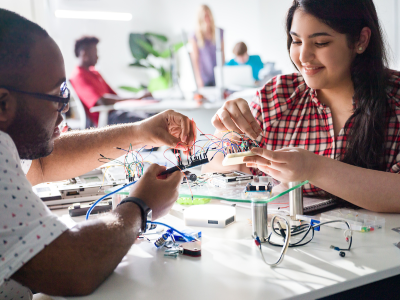
The Department have well equipped laboratories with more than 74 computers with various software’s and equipment’s relevant for the industry. Each laboratories have 66 sq.m of space as per AICTE norms. The following are the laboratories associated with EEE department.

Lab.No Odd Semester Even Semester
1 Analog Electronics Laboratory / Electronics and Devices Laboratory (ECE) Engineering Practices Laboratory
2 Project Laboratory Phase-1 Engineering Practices Laboratory
3 Computer Programming Laboratory Power System Simulation Laboratory (UG)
4 Power System Simulation Laboratory (PG) Power System Simulation Laboratory (PG)
5 Research Laboratory Research Laboratory
6 Microprocessor and Microcontroller Laboratory Mini Project Laboratory
7 Electric Circuit Laboratory Linear Integrated Circuits Laboratory (EIE)
8 Machines Laboratory-I Machines Laboratory-II
9 Renewable Energy Systems Laboratory Project Laboratory Phase-2
10 Control & Instrumentation Laboratory Power Electronics Laboratory
Laboratory
Department Library Book Details

The following are the Library lists of Stock details in our department Library. The Stock details are

S.No Stock Details Total Nos.
1 Total Number of Books 925 Nos.
2 Total Number of CDs 189 Nos.
3 Total Number of Thesis 371 Nos.
4 Total Number of Journals & Magazines 227 Nos.
5 Total Number of Anna University Question Banks 53 Nos.
Achievements
Students Achievements
Events
Research
Academic Year: 2021-25
Academic Year: 2020-21
S.No Name of the company No. of students placed
1 Accenture 13
2 WIPRO 11
3 Mindtree 5
4 Cognizant 7
5 TCS 7
6 Sutherland – Voice 6
7 Sutherland – Non Voice 4
8 NTT DATA 1
Total Students Placed 54
Academic Year: 2019-20
S.No Name of the company No. of students placed
1 Accenture 29
2 TCS 03
3 Cognizant 03
4 Worksbot 06
5 Innive 02
6 Sutherland 07
Total Students Placed 50
Academic Year: 2018-19
S.No Name of the company No. of students placed
1 Accenture 40
2 WIPRO 03
3 Infosys 01
4 Cognizant 05
5 NTT DATA 02
6 Sutherland 01
7 Tata Motors 02
Total Students Placed 54
Academic Year: 2017-18
S.No Name of the company No. of students placed
1 Accenture 22
2 Maveric Systems 1
3 Sanmina 01
4 NTT DATA 2
5 Chip Test 1
6 Sutherland-Voice 6
7 VDart Software Services Pvt. Ltd 2
8 Paragon Digital Services 8
9 Sutherland – Voice 1
Total Students Placed 44
Academic Year: 2016-17
S.No Name of the company No. of students placed
1 Accenture 36
2 Wipro 5
3 Capgemini 5
4 Sutherland 2
5 Sutherland -Voice 3
6 Gencor Pacific 2
7 e-Con Systems 1
Total Students Placed 54
Research
Ph.D. Awarded
S.No Name of Ph.D student Status
1 Dr. P. Yamuna Awarded
2 Dr. T. Santhosh Kumar Awarded
3 Dr. S. Padhmanabha Iyappan Awarded
Anna university approved Research supervisors:

1. Dr.R.Karthik, Associate Professor/EEE(Ref.No. 23.03.07)

Development activities
  • The Department of Science and Technology (DST), Ministry of Science and Technology Government of India has sanctioned Rs 40 Lakhs to our institute for Improvement of Science and Technology under FIST scheme.
  • Dr.R.Karthik, Associate Professor-EEE department have received Young Scientists Fellowship from TNSCST to carry out Research in IIT Kanpur for a period of Two months for the academic year 2020-21.
  • Department of Scientific and Industrial Research (DSIR), Ministry of Science and Technology, Government of India has recognized our institute as (SIRO) Scientific and Industrial Research Organization.
  • An Exclusive R&D Lab and Project Lab for Research scholars, PG and UG students for their product development been established in the EEE department
  • Software available for Research such as EUROSTAG, PSCAD, MATLAB
  • Computer & Internet Facilities: 76 & 1 Gbps
Research Scholars
S.No Name of scholar Faculty Mode of study Guide
1 Ms. K. Durga Devi Information & Communication Engineering Part Time Dr. R. Karthik (Joint Supervisor)
2 Mr. S. Venkatesh Electrical Engineering Part Time Dr. Ayyar K
3 Mr. V. Sudhakar Electrical Engineering Part Time Dr. Ayyar K
Research Scholars
S.No Name of scholar Faculty Mode of study Guide
1 Enhancements of agriculture activities using drones Dr. R. Karthik 3 Months (2018–19) TNSCST Rs 7,500
2 Energy harnessing from sound vibrations Mr. M. Kamala Kannan 3 Months (2017–18) TNSCST Rs 10,000
Alumni
Blog
Contact
Dr. K. Elango

Professor & Head,
Department of Electrical & Electronics Engineering,
SRM Valliammai Engineering College,
SRM Nagar, Kattankulathur – 603 203,
Chengalpattu District,
Tamil Nadu, India.

Contact Details

Mobile: +91 – 9043935446

Tel: 044 – 27454784 / 726, EXTN : 8161
EXTN : 8101

Fax: 044 – 2745 1504

Email: hod.eee@srmvalliammai.ac.in

Facilities

Library
Canteen
Banks
Scholarships
Transports
Medical Facilities
ISO